
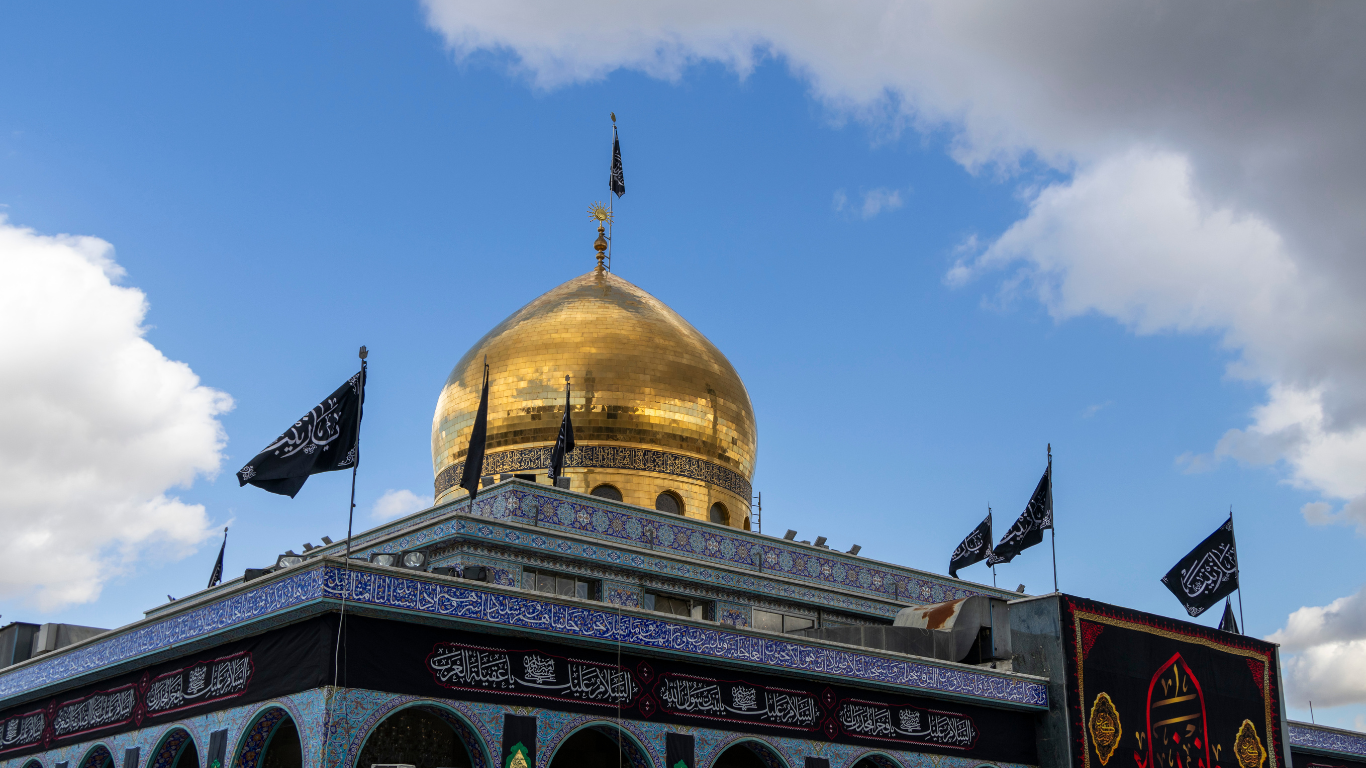
First of all, we present our congratulations to all believers on the auspicious birth of Aqilah Bani Hashim, Lady Zainab al-Kubra(sa).
According to the famous saying, Lady Zainab was born in the 5th year of Hijri, on the 5th of Jumada al-Ula, in Madinah1. The Noble Prophet named her Zainab; in fact, based on some narrations, the Angel Jibraeel (as) brought this name as an inspiration from Allah the Exalted.2
Many titles of Lady Zainab(sa) have been reported, the most important of which are: Aqilah Bani Hashim (The Wise Lady of the Hashemites), Arifah (The Gnostic), Fazilah (The Virtuous), Masoomah Sughra (The Lesser Infallible), Alimah Ghair Mu‘allamah (The Scholar who was not taught), Aqilat al-Nisa (The Wisest of Women), Fasiha (The Eloquent), and Shareekat al-Husayn (The Partner of Husayn)3. Furthermore, due to her bearing the great calamities of Karbala, she was also given the title of Umm al-Masaib (Mother of Calamities).4
Lady Zainab married Abdullah bin Ja‘far Tayyar in 17 Hijri, from whom, according to some sources, she had four sons — Ali, Awn, Abbas, Muhammad — and one daughter, Umm Kulthum5. We will point toward some virtues of Lady Zainab below.
The highest form of knowledge is that which is bestowed directly by Allah the Exalted, known as Ilm-e-Ladunni (God-given knowledge). According to Imam Zayn al-Abidin (as), the knowledge of Lady Zainab(sa) was also Ilm-e-Ladunni. That is why, addressing her, he said:
انتِ عالِمَةٌ غَيرَ مُعَلَّمَةٍ وفَهْمَةٌ غَيرَ مفھمَةٍ۔
Translation: "Dear aunt! You are a scholar who was not taught [by a human], and one who possesses understanding without having it explained [by others]."6
This is confirmed by the fact that during the caliphate of Ameer al-Momineen(as), Lady Zainab(sa) used to give lessons on the interpretation (Tafsir) of the Quran to the women of Kufa7. This virtue of Lady Zainab(sa) was granted to only a few selected people even among prophets and saints, let alone ordinary humans.
Lady Zainab(sa) elevated herself to such stages of worship that a personality like Imam Husayn(as) made a request to her:
’’یا اختي لا تنسيني في نافلة الليل‘‘
Translation: "My sister! Do not forget me in your Night Prayer (Salat al-Layl)."8
Imam Sajjad(as) stated regarding his aunt's worship during their captivity: "Aunt Zainab(sa), throughout all the stages from Kufa to Shaam, offered all her obligatory and recommended (nafilah) prayers. Even when she was overcome by hunger and weakness, she would perform her worship while sitting."9
The best adornment of a woman is chastity and veiling. What greater proof of Lady Zainab’s(sa) commitment to Hijab can there be than the fact that before the event of Karbala, no non-mahram (stranger) man had seen her10. Therefore, when she was presented without her veil and cloak in the court of Yazid, she protested, saying:
"O sons of the freed slaves of our grandfather! Is this justice that your women and maidservants are behind veils, while the daughters of the Prophet are made captives and paraded, their veils snatched away and their faces exposed?"11
The Noble Quran says:
وَ بَشِّرِ الصّابِرینَ * الَّذینَ إِذا أَصابَتْهُمْ مُصیبَةٌ قالُوا إِنّا لِلّهِ وَ إِنّا إِلَیْهِ راجِعُونَ"And give glad tidings to the patient ones, those who, when a calamity befalls them, say: 'Indeed we belong to Allah and indeed to Him we shall return.'"12The strength to remain patient during calamities is born from faith and certainty in Allah's sovereignty. One can estimate the faith of Lady Zainab(sa) from her response to Ibn Ziyad when he mockingly asked: "How did you find the action of Allah with your brother and your family?"
Lady Zainab(sa), with great patience and composure, replied:
ما رأيت الا جميلا"I saw nothing except beauty."13In summary, for all Muslims—and especially for Muslim women—the life of Lady Zainab Kubra(sa) is a guiding light. She demonstrated that at every turn of life, one must remain a servant of God. During divine trials, one must attach oneself even more closely to Allah. Furthermore, the limits of Sharia must be observed in every condition; one should never violate the Sharia by using circumstances as an excuse. Every test from Allah should be viewed as a divine gift, met with gratitude, while keeping an eye on the beautiful ultimate outcome. Through this perspective, bearing hardships and pains becomes easy.
May Allah the Exalted grant us the understanding of the religion. Ameen.
Reference
1A‘lam al-Nisa: in the Arab and Islamic world, Kahalah, Umar Rida, vol. 2, p. 91
2Al-Sayyidah Zainab, the pioneer of jihad in Islam, p. 42
3Al-Khasa’is al-Zaynabiyyah, pp. 52 and 53
4A‘yan al-Shi‘ah, vol. 7, p. 137
5 A‘yan al-Shi‘ah, vol. 7, p. 137
6Al-Ihtijaj ‘ala Ahl al-Lijaj, Tabarsi, vol. 2, p. 305
7A‘lam al-Nisa: in the Arab and Islamic world, same author, pp. 92 to 97
8Zabihullah Mahallati, vol. 3, p. 62 / Ja‘far al-Naqdi
9Zainab al-Kubra, daughter of Imam Ameer al-Momineen Ali bin Abi Talib, p. 62
10‘Awalim al-‘Ulum wa al-Ma‘arif wa al-Ahwal min al-Ayat wa al-Akhbar, p. 95
11Bihar al-Anwar, vol. 45, p. 134
12Al-Baqarah, 155 to 157
13Bihar al-Anwar, vol. 45, pp. 116 and 115